Bryan Wahl and Hayden Erdman
Healthcare architecture succeeds or fails long before construction begins. At its core, user engagement is the most reliable path to creating clinical environments that genuinely support care delivery. The objective isn’t to gather superficial input or secure early buy in. It is to move far beyond aesthetics and make sure users fully understand the proposed environment before a single brick is laid. When clinicians, nurses, and staff can visualize and inspect space in advance, they help define what “success” means. It’s not a finished architectural product, but a functioning, intuitive workplace that enables them to do their jobs safely and efficiently. In that sense, engagement is not an optional courtesy in the design process, but an essential strategy that protects time, capital, and trust. It aligns clinical realities with design intent so the project can move from concept to construction with clarity, momentum, and confidence. When stakeholders are meaningfully involved, decisions are better informed, disruptions are reduced, and the project is positioned to reach fruition as a facility that performs as intended from day one. When staff can work smoothly and confidently, patients experience calmer interactions, clearer wayfinding, and more consistent care.
Methods of Engagement
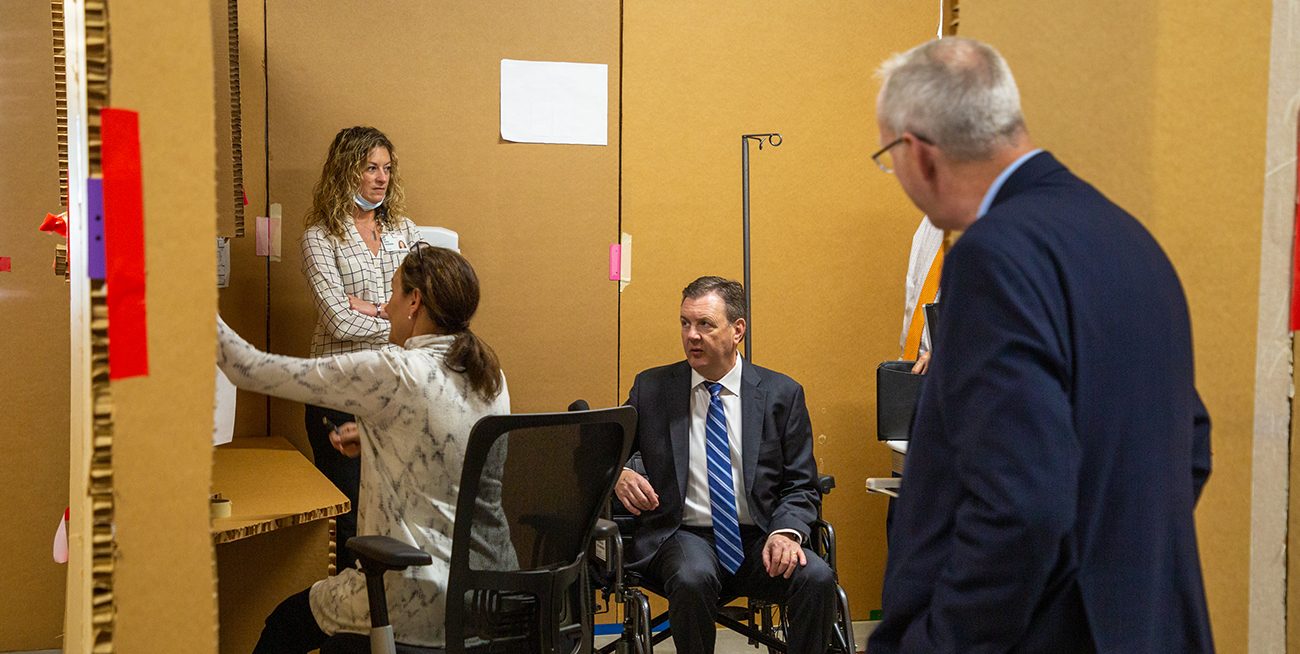
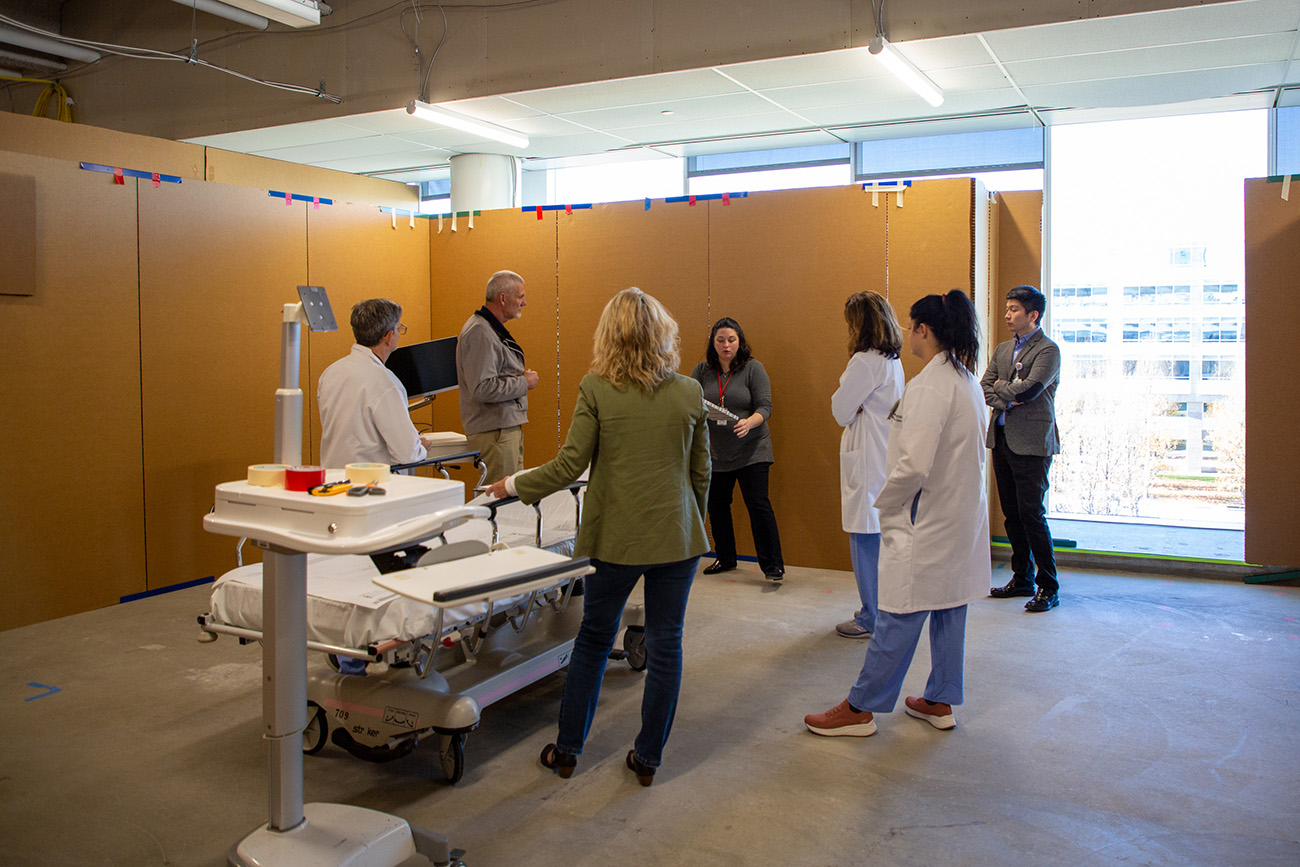
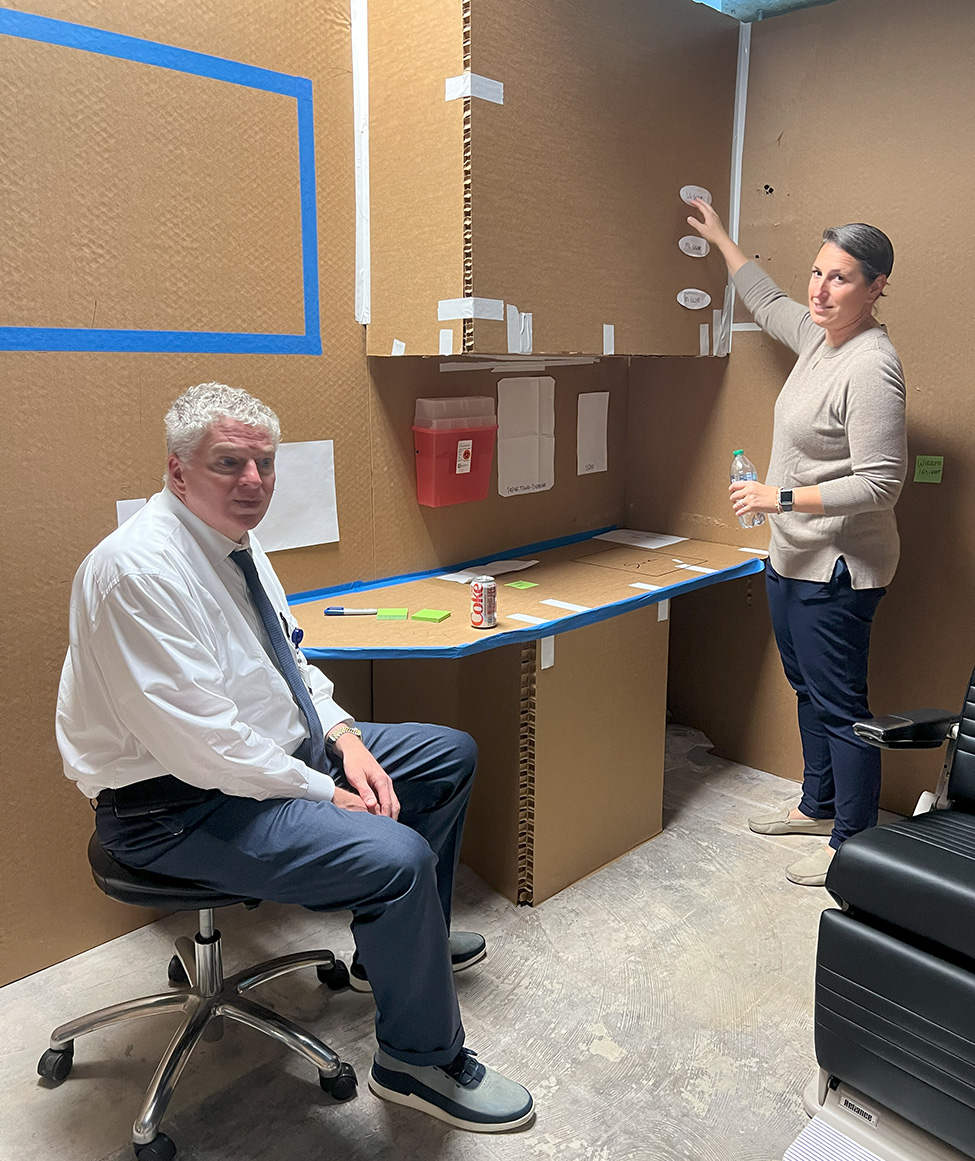
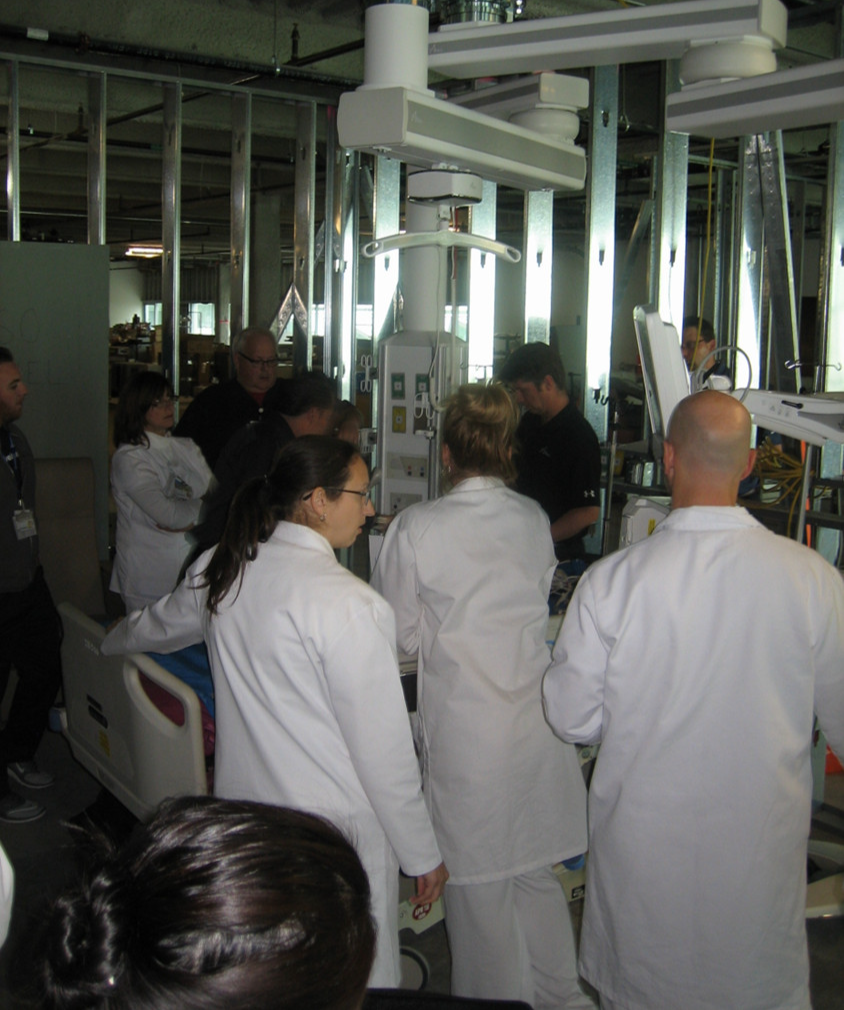
An effective engagement process uses a full toolkit of methods. Each method is selected to match the complexity of decisions that users need to make. Digital engagement is a common starting point because it is fast and familiar, yet its speed comes with limits. Many clinicians are not trained to read drawings or interpret architectural graphics. When decisions depend solely on a screen–shared floor plan or a static rendering, misunderstandings are almost guaranteed. To remove that guesswork, design teams increasingly turn to tools that create progressive levels of realism. Cardboard mock-ups allow teams to grasp scale and orientation in minutes, revealing issues that two dimensional drawings cannot. Virtual reality and panoramic renderings offer a deeper level of immersion, enabling care teams to walk through future spaces and experience flow, sightlines, and adjacencies before anything is built. Physical mock-ups take this even further. Though they come with a cost, they often save exponentially more on the backend. Built rooms allow clinicians to test the exact placement of outlets, equipment booms, headwalls, storage, and workflow choreography, while simultaneously giving project teams practical insight into how the space will be constructed. No digital tool can replace the clarity that comes from watching a physician reach for an outlet or maneuver a boom in a full-scale prototype. This is the difference between imagining a workflow and experiencing one.
What Happens When You Don’t Engage?
When engagement is skipped or minimized, the consequences become painfully visible on move-in day. The most common comment received is, “I didn’t know it would look like this”. This signals a breakdown not in competence, but in communication. Misaligned understanding leads to costly post–construction changes, from retrofitting casework to reworking sightlines to adding outlets and lighting after teams have already moved in. These corrections not only consume capital but erode the confidence of the staff who must work around them and delay the time where the medical professionals can provide care. Skipping engagement essentially replaces shared understanding with individual assumptions, and assumptions are a poor foundation for environments as complex and high stakes as hospitals. The solution is a collaborative design process that creates a shared reality early and validates it together.
Designing Together
Trust is built the moment architects shift from “designer” to “collaborator.” This shift begins with the willingness to enter the clinical world rather than merely observing it from a distance. Shadowing clinicians, nurses, and support staff reveal details that rarely appear in initial programming documents. How often a nurse leans into a headwall, the tight choreography of a code response, the awkward reach for a supply cabinet that interrupts sterile technique are all things that can be observed. These observations surface the true stakes of design decisions. When those insights then appear tangibly in mock-ups or revised layouts, trust deepens because the user sees their experience reflected in the design of the space. Expertise stops being something the design team claims and becomes something the user can verify.
User engagement is not a single moment; it is a cycle that begins before drawings are created and continues after occupancy. Early in the process, asking the right questions about bottlenecks, safety risks, pain points, and future goals helps clarify what must be validated before the design is set. As the design takes shape, the engagement process becomes a dialogue of prototyping, testing, refining, and confirming. And after the building opens, returning to the space and asking, “How is this actually working for you?” closes the loop. Post occupancy feedback uncovers lessons that inform future projects and ensure continuous improvement, both in the environment and in the design methodology itself.
Examples from recent projects illustrate the transformative power of thorough engagement. At Emory Eye Center, constructing an entire pod which included six exam rooms, procedure rooms, and offices allowed staff to experience not just isolated rooms but complete operational sequences. This full-scale prototype didn’t simply validate the layout as it reshaped how teams envisioned their workflows and how they would use the space. On projects such as Mentor Hospital and The Cole Eye Institute Expansion, combining cardboard studies, VR walkthroughs, and physical mock-ups enabled frontline staff to articulate precise feedback, reduce uncertainty, and streamline decisions. Engagement also provided construction teams with insights that accelerated the building and reduced rework. Shadowing played an important role in futureproofing as well by observing current workflows and comparing current state to desired future state. The design team could differentiate between temporary habits and inherent operational needs, creating spaces that can flex with evolving technology and care models.
Putting the Patient First
In modern healthcare architecture, listening is not passive. We treat it as an active design tool. Great hospitals and clinics are measured not by visual spectacle but by the absence of surprises, the clarity of workflow, and the measurable alignment between environment and care delivery. When architects listen deeply, prototype thoughtfully, and validate decisions collaboratively, clients receive not only what they asked for but what they truly need. At its best, architecture becomes a quiet partner in the healing process, enabling clinicians to focus on the patient rather than the environment around them. And that begins with listening to the people who will ultimately bring the space to life.